
Soft furnishings can turn one room into several learning settings. Here's how to plan the zones, and what the research says.
Most Australian classrooms are still a single rectangle with a single layout. In the University of Melbourne's ILETC survey, principals said traditional classrooms made up roughly 75% of all spaces, yet in one lesson students might need to collaborate, concentrate, present and reset. The good news is that zoning is an easy fix. No rebuild needed, just carve out distinct areas with modular, movable furniture.
Why the space matters
The University of Salford's Clever Classrooms study found classroom design explained 16% of the variation in learning progress over a year across 3,766 pupils. Light, temperature, air quality, colour and individualised design were among the biggest factors.
Australian research backs this up. The ILETC survey found students in flexible environments showed more signs of deep learning. There's a catch, though. Lead investigator Wes Imms has stressed that it's how a space is used that makes it innovative. Furniture alone won't change learning, but the right pieces can help.
Four zones to try
1. Collaborate
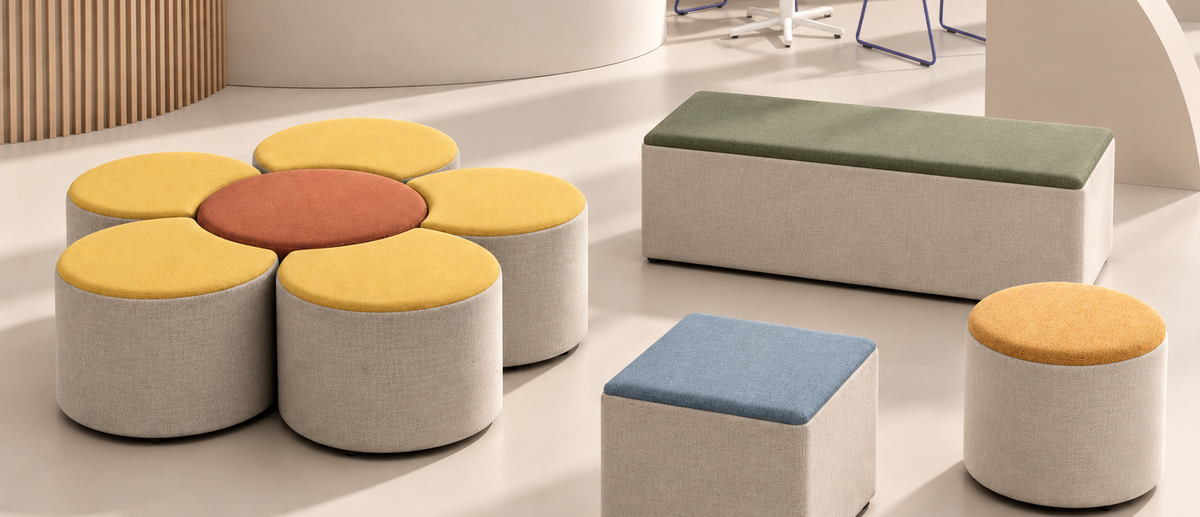
Group work works best with inward-facing seating you can rearrange in seconds. Our Jigsaw Ottoman Suite and Flower Ottoman Set are great for small teams. Want something more defined? Our Booth Suite pairs two lounges with a flip table, and our Booth Lounge marks out a group's patch.
2. Focus
Some students just need to get their heads down. Our Study Hub range, in single, two-seater and three-seater formats, gives senior students a quiet corner to do just that.
3. Read and reset
Every classroom needs a spot for students who are overstimulated, finished early or simply need a breather. Our Large Commercial Beanbag, Ergerite Low Floor Seat and Cushion Caddy with 16 Floor Cushions make the space feel different from the desk area, and the Modulo Bookcase Suite gives it a soft edge.
4. Gather and present
Whole-class discussions and teacher instruction need a space where everyone can see. We designed the Soft Theatre Ottoman Suite for exactly this, and our Wedge Ottoman and Curved Ottoman let you build a tiered or curved layout.
Making it work
- Start with the learning, not the furniture. List what happens in the room across a week, then decide how many zones you need. Two well-used zones beat five empty ones.
- Keep it movable. A zone that can't change will eventually fall flat. ILETC's Transitions Pathway maps tools and strategies against 14 characteristics of good space use, which shows how much teacher practice matters. Choose pieces light enough for students to move with a little guidance.
- Protect sightlines. Low furniture lets teachers see every zone from wherever they're standing.
- Bring students in. Ask where they like to work. Students who help set up a space tend to use it as intended.
- Choose for durability. Soft furnishings get a workout, so look for commercial-grade construction and easy-to-clean finishes. Our team is always happy to chat about warranty and replacement covers.
Start small
Trial one zone, like a reading corner, and see how students use it over a term. Then tweak as you go. The aim is a room that changes as the lesson does.
References
- Barrett, P., Davies, F., Zhang, Y. & Barrett, L. (2015). The impact of classroom design on pupils' learning: Final results of a holistic, multi-level analysis. Building and Environment. Summary: Clever Classrooms, University of Salford
- Imms, W., Mahat, M., Byers, T. & Murphy, D. (2017). Type and Use of Innovative Learning Environments in Australasian Schools: ILETC Survey 1. University of Melbourne. ERIC record
- Teacher Magazine (ACER): Traditional classrooms and Innovative Learning Environments